A fintech team replaced 14 cron-job Python scripts — none of them documented — with visual pipelines. The business team can now read the logic without engineering help.
Finance · Data Pipelines
The open-source platform for workflow automation, AI agents, data pipelines, dashboards, and full applications. No-code to pro-code. Free for individuals — forever.
Solution engineering means you describe what you need — we handle everything else.
You focus on your business logic. Flow-Like manages the rest.
Desktop, cloud, edge, air-gapped — deploy anywhere with one click.
WASM sandboxing, SBOM, zero telemetry, full audit trail built in.
Every execution logged. Every AI decision traced. Every cost tracked.
Typed connections between nodes. Errors caught before execution, not after.
Approval gates, version control, role-based access. Enterprise-ready out of the box.
From a Raspberry Pi to a production cluster. Same workflow, same engine.
Flow-Like isn't a different tool depending on who you are — it's the same workflow automation engine, used differently. Here's what that looks like for real teams.
Automate onboarding across 5 systems in a day
HR submits a form. Flow-Like provisions accounts in Azure AD, assigns Jira boards, invites to Slack channels, and notifies the manager — all in one visual workflow that anyone on the team can read and modify.
Flow-Like is still in alpha. Enterprise support and SLAs are available, but expect to be an early adopter, not a late majority buyer.
Build ETL pipelines your business team can actually read
Pull daily sales from Postgres, clean and validate, aggregate by region, and push to a live BI dashboard. Every connection is type-checked — schema mismatches are caught before the data pipeline runs, not at 3am.
If you need deep integration with dbt, Airflow, or Spark ecosystems, check the node library first. Coverage is broad (1,000+ nodes) but not every niche tool has a node yet.
Ship agents with guardrails and full observability
Build a support agent: user message → PII redaction → Claude with RAG → quality gate → response. Every prompt, token count, latency, and cost is logged automatically. Swap models or add guardrails without touching code.
If you're deep in the LangChain/LangGraph ecosystem, Flow-Like is a different paradigm (visual DAG vs. code-first). Powerful, but a different mental model.
Build what you need without filing an engineering ticket
Pull open deals from your CRM every Monday. Have an AI summarize trends and risks. Push a visual report to a Slack channel. All built on the drag-and-drop canvas, no code, no waiting for a sprint slot.
Complex integrations may still need an engineer to create a custom node. Flow-Like makes collaboration easy, but it doesn't eliminate the need for technical help on edge cases.
Build a smart home dashboard for free, on a Pi
Connect MQTT sensors, transform power data into kWh, detect anomalies, and display everything on a mobile dashboard. Runs locally on a Raspberry Pi. No cloud. No subscription. No account.
The community is still growing (200+ Discord members). More general-purpose and less home-automation-specific than Home Assistant — but more powerful when you need to combine IoT with data pipelines, AI agents, or custom UIs.
Ship apps in hours, not sprints
Build a feature request tracker: custom form UI → AI categorization → manager approval gate → auto-create Jira ticket. The internal tool you built in a morning is the same one running in production six months later.
Flow-Like's UI builder shipped in v0.0.8. It's capable but newer than the workflow engine. For pixel-perfect custom UIs, you may still want a designer writing custom components alongside the canvas.
"We replaced three separate tools and cut our deployment time by 80%."
"Our business analysts build automations that used to require a full sprint."
"Runs on my Pi. No cloud. No subscription. This is what open source should be."
1,000+ built-in nodes covering the full spectrum. From data pipelines and ETL to customer-facing applications — with infinite room to extend using our developer SDK.
Interactive dashboards pulling from any data source — real-time, embedded, or standalone. A modern BI alternative built on your workflow engine.
"We replaced three Tableau licenses with one Flow-Like project."
Explore →Replace brittle scripts and RPA bots with visual, error-handled workflows anyone on the team can follow.
"HR onboarding went from 3 hours of manual work to one click."
Explore →Build multi-step AI agent systems on the visual canvas. Every prompt, token, cost, and decision logged with full observability.
"Full observability — we know exactly why the agent made each decision."
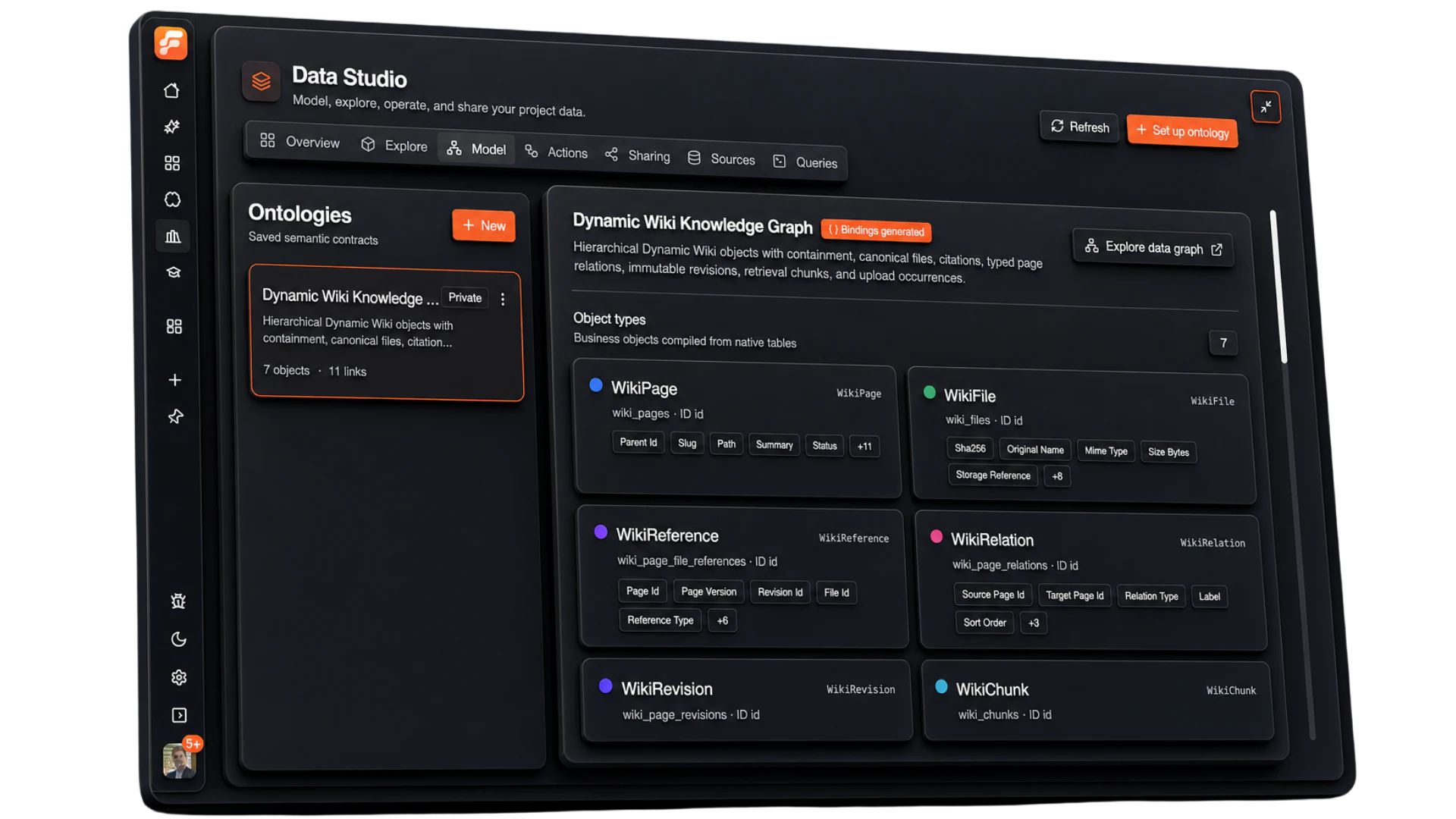
Explore →Visual ETL/ELT pipeline builder with type-safe connections. Ingest, transform, catalog — no code required.
"Our data team builds pipelines. Business reads them. No translation needed."
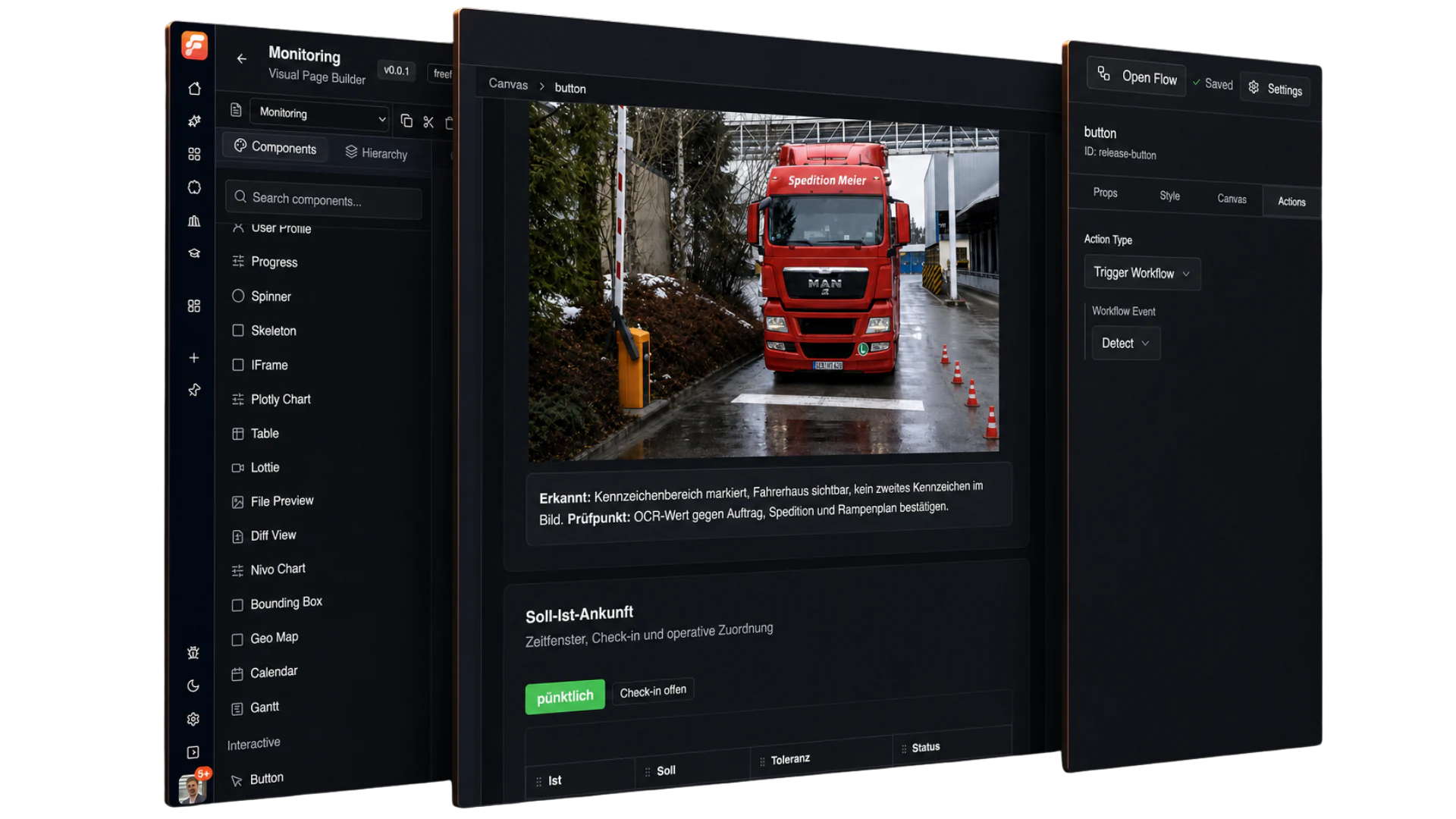
Explore →Ship web, desktop, or mobile interfaces alongside your business logic — from the same project. No separate front-end tool.
"We shipped an internal tool in a day that would've taken engineering two sprints."
Explore →Connect Kafka, MQTT, ERPs, CRMs, REST APIs, and hundreds more. The integration hub for your entire ecosystem.
"Connected our ERP to Slack to Jira in an afternoon."
Not six tools wired together — one project, one deployment. Build a data pipeline that feeds an AI agent that powers a dashboard inside a customer-facing app. That's solution engineering.
Business analysts, citizen developers, engineers, and designers — one shared workspace where everyone contributes to the solution in their own language.
Define requirements visually. Annotate workflows, set approval gates, validate logic — no code needed. Whether you're a citizen developer or a domain expert, your knowledge drives the solution. FlowPilot AI helps you build what you describe in plain language.
Write custom nodes in 15+ languages. Define type contracts, configure infrastructure, own the execution layer — with the full Rust SDK. Low-code when you want speed, pro-code when you need control.
Design front-end interfaces wired directly into the workflow automation engine. Ship dashboards, forms, and apps connected to live data from day one.
The demo you build on Monday ships on Friday. The workflow engine enforces correct architecture, compliance, and performance from the first node. No rewrite required.

Drag, connect, run. Validate in seconds.

Add error handling, tests, governance.

One click. Same workflow. No translation.
"The architecture you ship is the architecture you prototyped. The engine enforces type safety, compliance, and performance from node one. Zero translation layer. Zero rewrite."
Every solution you engineer — dashboard, AI agent pipeline, or full application — runs on the same type-checked, high-performance Rust workflow engine.
Type-safe drag-and-drop building
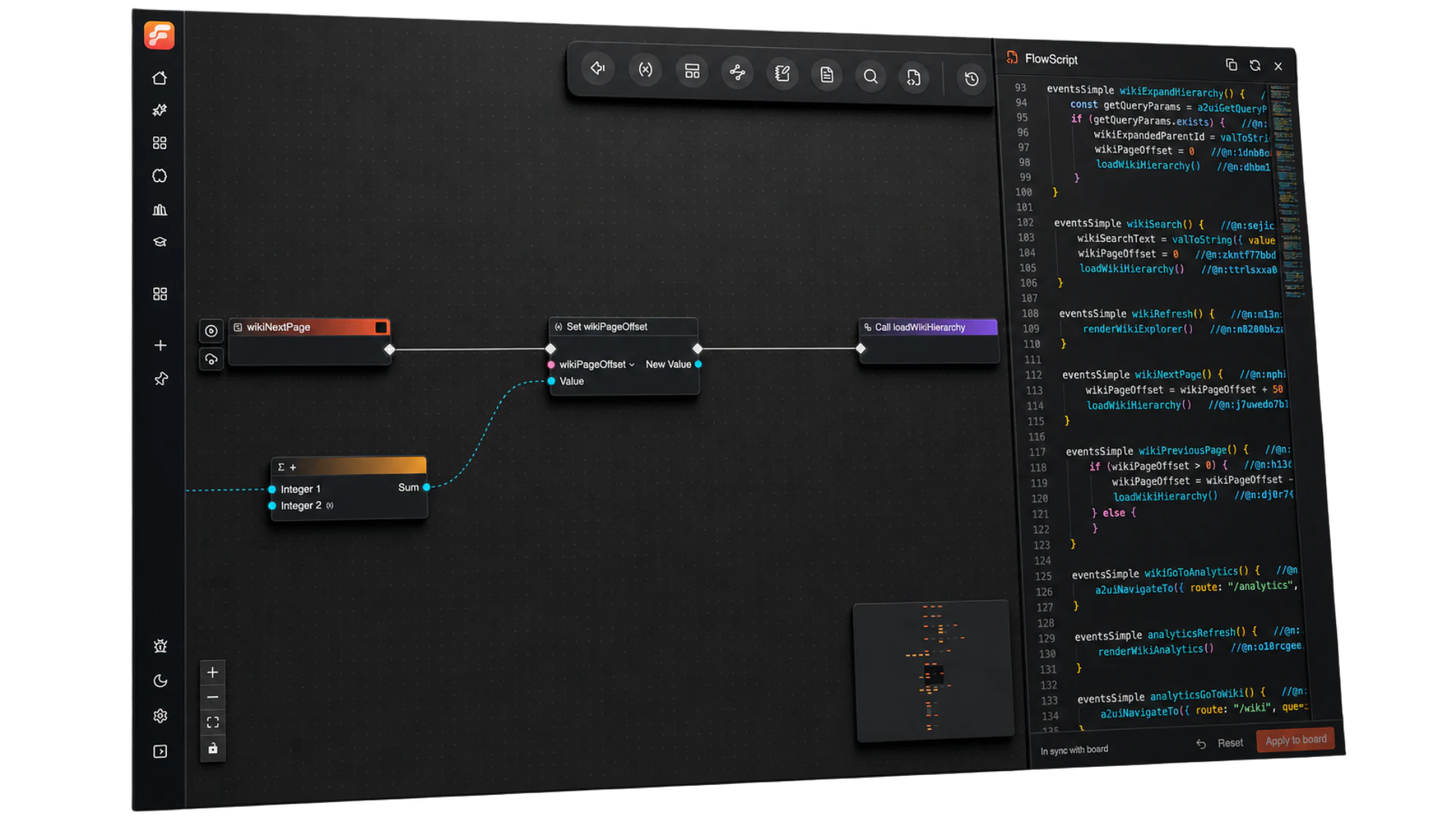
Drag nodes onto the canvas, connect them with typed pins, and the visual workflow editor validates every connection before you run. Mismatched data types? Caught instantly — not after your demo crashes.
Built-in version history lets you branch, merge, and roll back. Every change tracked, every collaborator visible. No-code for business users, pro-code for engineers — on the same canvas.
A full type system making sure your solution makes sense before you ever hit run.
AI Copilot for Workflow Automation
Describe what you need in plain language. FlowPilot, the built-in AI assistant for workflow building, translates your intent into typed, connected workflows — then helps you debug, optimize, and document them.
Context-aware: FlowPilot knows your project's nodes, types, and data sources. Ask it to explain a flow, suggest improvements, or generate new workflow sections.
Less chatbot, more colleague who already read the docs.
~0.6ms execution, 244k events/second
Compiled Rust workflow engine running a typed DAG with Protobuf serialization. File-based projects on an object store abstraction — local filesystem, S3, R2, GCP, or Azure Blob.
~0.6ms per execution. 244k events/second. Your infrastructure costs drop — or you don't need much infrastructure at all.
Custom nodes run in WebAssembly (WASM) sandboxes for isolation and security. The visual editor is your entry point, but there's no ceiling.
→ Architecture deep-dive for CTOs & tech leadsNot "open core" with the interesting parts behind a paywall. The entire codebase is open, governance is built in, and you can inspect everything. Self-host on your infrastructure with full data sovereignty.
Role-based permissions with approval workflows. Define who can view, edit, approve, and deploy across teams.
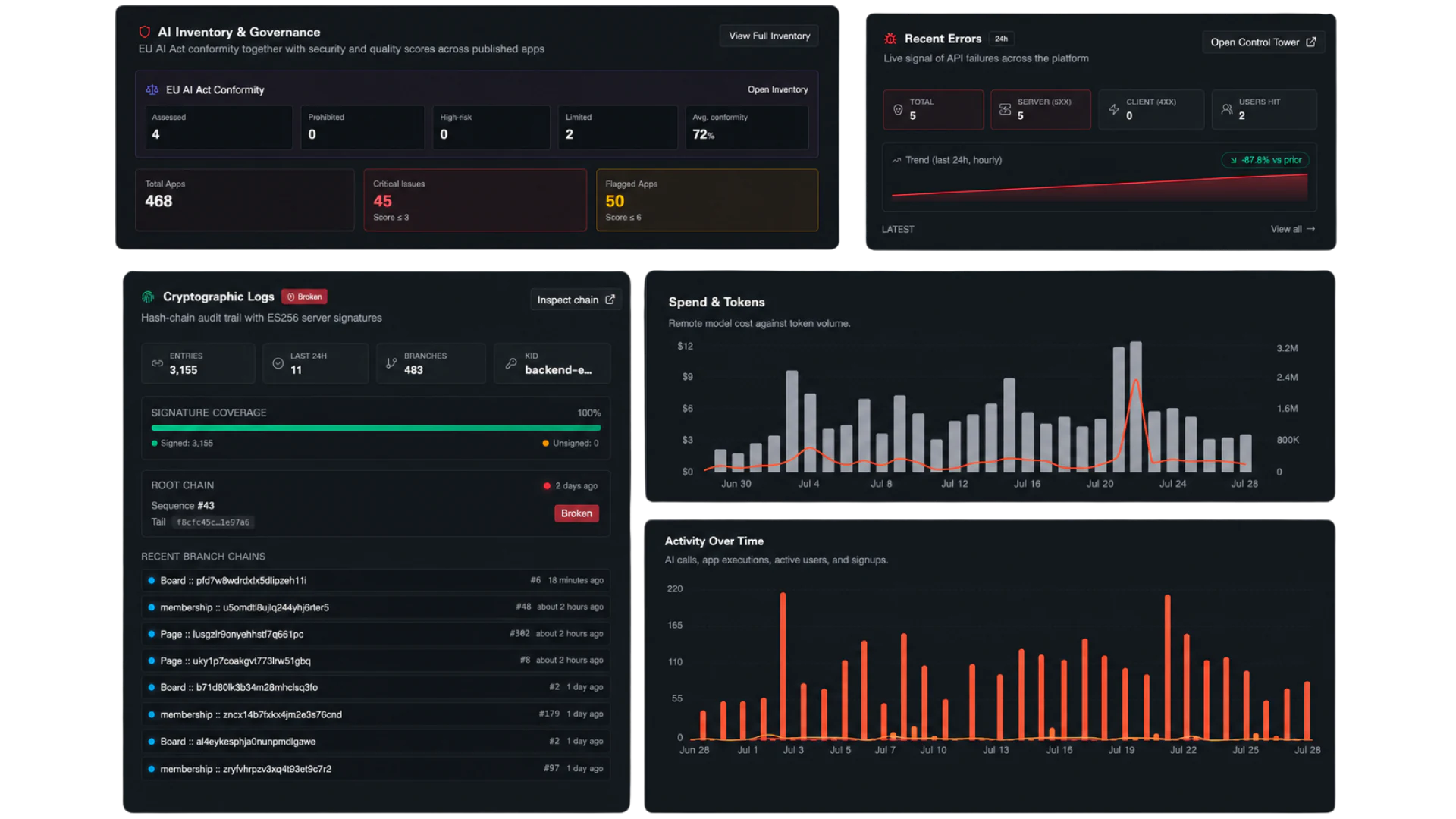
Full execution trace on every workflow run. Inputs, outputs, decision branches, timestamps, user context.
2,073 dependencies, all tracked. Complete software bill of materials with each release.
Verify →SOC 2 aligned, TISAX controls, Prowler assessed. Continuous assessment, not point-in-time.
Verify →A fintech team replaced 14 cron-job Python scripts — none of them documented — with visual pipelines. The business team can now read the logic without engineering help.
Finance · Data Pipelines
An enterprise shipped a customer support agent with full observability — every prompt, every token, every cost logged with a complete, auditable decision trace.
Enterprise SaaS · AI Agents
A government contractor deployed Flow-Like in an air-gapped environment: zero telemetry, complete SBOM, no modifications required to pass a strict security review.
Government · Air-Gapped Deployment
A 2,000-person manufacturer reduced a 3-hour, 5-system onboarding workflow to a single click — built by IT, readable and approvable by operations without translation.
Manufacturing · Process Automation
A fintech team replaced 14 cron-job Python scripts — none of them documented — with visual pipelines. The business team can now read the logic without engineering help.
Finance · Data Pipelines
An enterprise shipped a customer support agent with full observability — every prompt, every token, every cost logged with a complete, auditable decision trace.
Enterprise SaaS · AI Agents
A government contractor deployed Flow-Like in an air-gapped environment: zero telemetry, complete SBOM, no modifications required to pass a strict security review.
Government · Air-Gapped Deployment
A 2,000-person manufacturer reduced a 3-hour, 5-system onboarding workflow to a single click — built by IT, readable and approvable by operations without translation.
Manufacturing · Process Automation
A maker runs solar panels, heat pump, and power consumption dashboards on a Raspberry Pi using Flow-Like — fully offline, no subscriptions, no cloud dependency.
Smart Home · Local-First
FlowPilot turns a plain-English description into a working workflow. Non-technical users tweak nodes and ship automations — no knowledge of typed DAGs required.
Business Automation · No-Code
A weekend project: a personal finance tracker with AI categorization that runs as both a desktop and a web app — without writing a single line of backend code.
Personal Finance · Cross-Platform
Freelance developers whitelabel Flow-Like for clients — each gets a branded automation tool, while the developer earns recurring revenue through OEM licensing.
Whitelabel · Developer Revenue
A maker runs solar panels, heat pump, and power consumption dashboards on a Raspberry Pi using Flow-Like — fully offline, no subscriptions, no cloud dependency.
Smart Home · Local-First
FlowPilot turns a plain-English description into a working workflow. Non-technical users tweak nodes and ship automations — no knowledge of typed DAGs required.
Business Automation · No-Code
A weekend project: a personal finance tracker with AI categorization that runs as both a desktop and a web app — without writing a single line of backend code.
Personal Finance · Cross-Platform
Freelance developers whitelabel Flow-Like for clients — each gets a branded automation tool, while the developer earns recurring revenue through OEM licensing.
Whitelabel · Developer Revenue
// Define a custom node in Rust — 15 lines use flow_like::prelude::*; #[derive(Node)] pub struct SentimentAnalyzer { #[input] text: String, #[output] score: f64, #[output] label: String, } impl Execute for SentimentAnalyzer { async fn run(&self, ctx: &Context) -> Result<()> { let result = ctx.analyze(&self.text).await?; self.score.set(result.score); self.label.set(result.label); Ok(()) } }
# Define a custom node in Python — 12 lines from flow_like import Node, Input, Output, Context class SentimentAnalyzer(Node): text: Input[str] score: Output[float] label: Output[str] async def run(self, ctx: Context): result = await ctx.analyze(self.text) self.score.set(result.score) self.label.set(result.label)
// Define a custom node in TypeScript — 14 lines import { Node, Input, Output, Context } from '@flow-like/sdk'; export class SentimentAnalyzer extends Node { @Input() text: string; @Output() score: number; @Output() label: string; async run(ctx: Context): Promise<void> { const result = await ctx.analyze(this.text); this.score.set(result.score); this.label.set(result.label); } }
// Define a custom node in Go — 20 lines package nodes import "github.com/tm9657/flow-like-sdk-go" type SentimentAnalyzer struct { Text flowlike.Input[string] Score flowlike.Output[float64] Label flowlike.Output[string] } func (n *SentimentAnalyzer) Run(ctx *flowlike.Context) error { result, err := ctx.Analyze(n.Text.Get()) if err != nil { return err } n.Score.Set(result.Score) n.Label.Set(result.Label) return nil }
Your laptop, a customer's data center, edge computing devices, or any cloud. Offline-first, sync when connected. Multi-cloud deployment with a single workflow definition.
Rust, Python, TypeScript, Go, Java, C#, Kotlin, C++, and more. Your language, your nodes.
Supported languages and frameworks
Build once, deploy anywhere — from a single binary to a full cloud cluster.
It's here! Our first major release of the year, refining self-hosting capabilities, adding a UI-Builder, Web-App access, and BI features.
Read →The self-hosting release. Kubernetes & Docker-Compose setups with observability, multi-cloud blob storage, backend-agnostic desktop apps, and substantial UX, DX, and core improvements.
Read →From "wouldn't it be nice" to "holy cow, it works" in one rotation of the earth.
Read →Our biggest update yet. Introducing FlowPilot, a dedicated Agent Builder, Real-Time Collaboration, and a massive library of new nodes for Microsoft Office, Google Workspace, GitHub, and more.
Read →An honest comparison of Dify and Flow-Like—two powerful platforms that excel in different scenarios. Learn when to use Dify's GenAI focus versus Flow-Like's typed automation.
Read →No more manual schemas: define pins on your functions and the agent interface does the rest. Reuse functions for deterministic calls, MCP tools supported, more built-ins coming.
Read →No spam — just releases, deep-dives, and the occasional workflow tip. Unsubscribe anytime.
Yes. Free for individuals with unlimited local execution — no account required, no execution limits, works fully offline. Pro tiers for teams via SaaS or self-hosting. Enterprise gets fixed pricing per use case, unlimited users, unlimited executions.
No. The visual drag-and-drop workflow builder lets you build complete solutions by connecting nodes on a canvas. No-code for business users, pro-code when engineers want to extend. Coding is available but never required.
Yes. Flow-Like is offline-first. The desktop studio works without any internet connection. Self-hosted deployments can run fully air-gapped. Sync when connected, or never connect at all.
Yes. Flow-Like is a visual AI agent builder with built-in RAG, vector search, PII detection, model-agnostic LLM nodes, and full observability. Build multi-step agent systems with guardrails on the canvas.
OpenAI, Anthropic Claude, Google Gemini, and local models via llama.cpp — all as drag-and-drop canvas nodes. Bring your own API keys or run fully local. Model-agnostic by design.
Yes. Designed for on-premise, air-gapped, private cloud, or hybrid deployments. Self-host on your infrastructure — your data never has to leave.
Every LLM call is logged with inputs, outputs, token counts, costs, and timing. Enforce approval gates, rate limits, and model allow-lists at the workflow level. Full audit trail on every AI agent execution.
Every workflow execution generates a full trace: inputs, outputs, decision branches, timestamps, and user context. Export in standard formats for compliance teams. SOC 2 aligned, TISAX controls, continuous Prowler assessment.
Both are open-source workflow automation tools. Flow-Like differs in three ways: a Rust-powered engine (~0.6ms vs. Node.js execution), a full type system that validates connections before runtime, and the ability to build not just automations but also BI dashboards, AI agents, data pipelines, and full applications in one project. n8n is excellent for event-driven automation; Flow-Like is a solution engineering platform for teams building more complex systems.
Zapier and Make are cloud-only SaaS automation tools. Flow-Like is open-source, self-hostable, and runs offline. It also goes beyond automation: you can build BI dashboards, AI agents, data pipelines, and full applications on the same canvas. If you need a free, self-hosted alternative with more power, Flow-Like is worth evaluating.
Yes. Our onboarding includes migration support for RPA bots, Python scripts, and orchestration tools. We'll audit, document, and convert your highest-value workflows.
Download the Studio and start building — locally, offline, no account required. Or jump into the web app. Free workflow automation for individuals, forever.