

An enrichment workflow may ask the same service for the same reference data many times. If the answer remains useful for a while, a cache can let later runs reuse it. The important design decision is where the workflow chooses between using the saved value and performing the expensive work.
Flow-Like provides cache nodes for small values shared between runs. Build the hit and miss branches explicitly so you can see which work is skipped and when the data is refreshed.
Choose a key and a scope
Use Open Cache to create the handle passed to the read and write nodes. App scope shares entries with people who can run the app. User scope keeps entries associated with the person who triggered the run. Choose User scope when the result depends on that person’s access or preferences.
A key identifies the question being answered. For a public product-reference lookup, include the product identifier and any locale or schema version that changes the result. Two requests that can produce different valid answers should not accidentally share a key.
Use a namespace to group related entries. That gives you a way to invalidate the group when a source or result format changes. It also prevents unrelated flows from colliding merely because both use a short key such as settings.
Branch on the read result
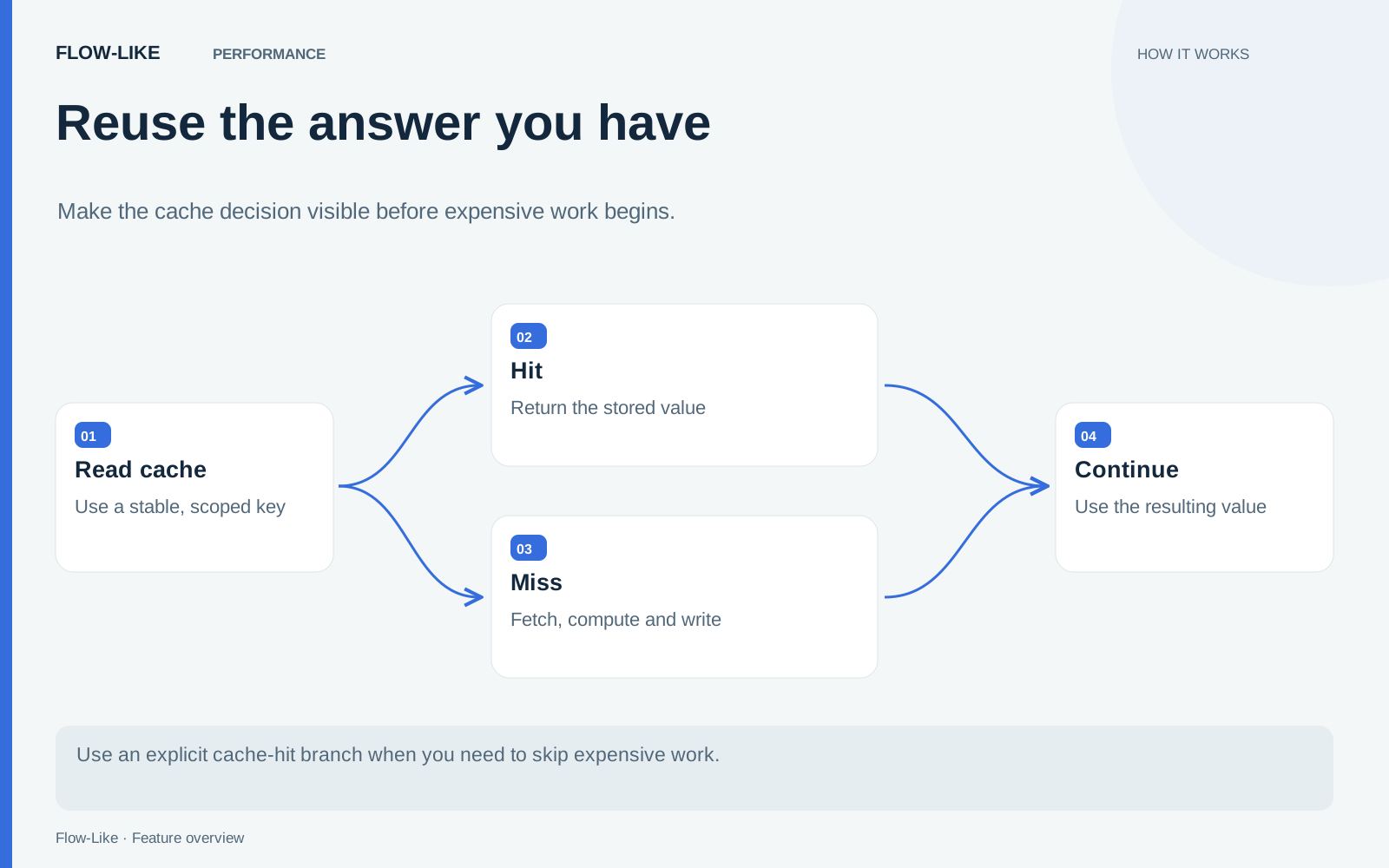
Connect Read Cache and inspect Found. If it is true, use Value. If it is false, fetch the reference data, validate the response, write it with a chosen lifetime, and continue with the newly obtained value.
Branch on Found rather than testing whether Value is null. The node reports a miss when an entry is absent or expired, and a stored value has its own meaning. Keep the control signal separate from the data.
The first lookup for a product takes the miss branch and saves its reference data. Another request for the same product and locale uses the saved value until it expires or is deleted. A different locale gets a different key and can fetch its own answer. The visible branch makes that behavior part of the workflow’s structure.
The Read Cache implementation exposes that contract directly.
Understand Get or Write before using it
Get or Write Cache returns an existing live value or stores its fallback. However, its implementation evaluates the fallback input before attempting the cache operation. Wiring an expensive computation into that input does not, by itself, prevent the computation on a hit.
Use the explicit read-and-branch pattern when skipping that work is your objective. Get or Write can support a different pattern in which a cheap claim value is inserted and Written determines which caller proceeds. That requires careful handling of unfinished work and failures. The node source makes the evaluation order visible.
This interactive teaching simulation illustrates the hit/miss decision. It does not call a service or operate your app’s cache.
Try the idea · illustrative data
Follow the cache branch
Run the same request twice. Then change the source version or advance the example clock to see why the workflow computes again.
Key: example-team:handbook:v1
Choose a source version and run the example.
- Compute branch runs
- 0
- Cache hits
- 0
- Simulated hour
- 0
A browser-only model of an explicit hit/miss branch. Counts are example actions, not performance measurements. Data resets when this page reloads.
Decide when the answer becomes stale
Expiration expresses how long you are willing to reuse an answer. It cannot know that the source changed early. Add deletion or namespace invalidation after a known change, such as replacing the reference dataset or modifying the shape of the cached result.
Cache small, frequently reused values. Put large documents in app storage and cache an appropriate reference or compact result. Offline apps use their local cache path; server deployments use a configured store. The same workflow pattern keeps the hit/miss decision explicit across those environments. The cache backend source describes the store selection and its limits.
Two runs can still both observe a miss before either writes. The basic pattern avoids repeated work on later hits; it does not promise that concurrent misses execute only once. If that matters, design coordination and recovery explicitly. Keep the cache replaceable, and keep the source of truth somewhere you can recover from when a cached value disappears.
Get automation insights delivered
Sign up for our newsletter to receive the latest updates on Flow-Like, automation best practices, and industry insights. No spam — just valuable content.