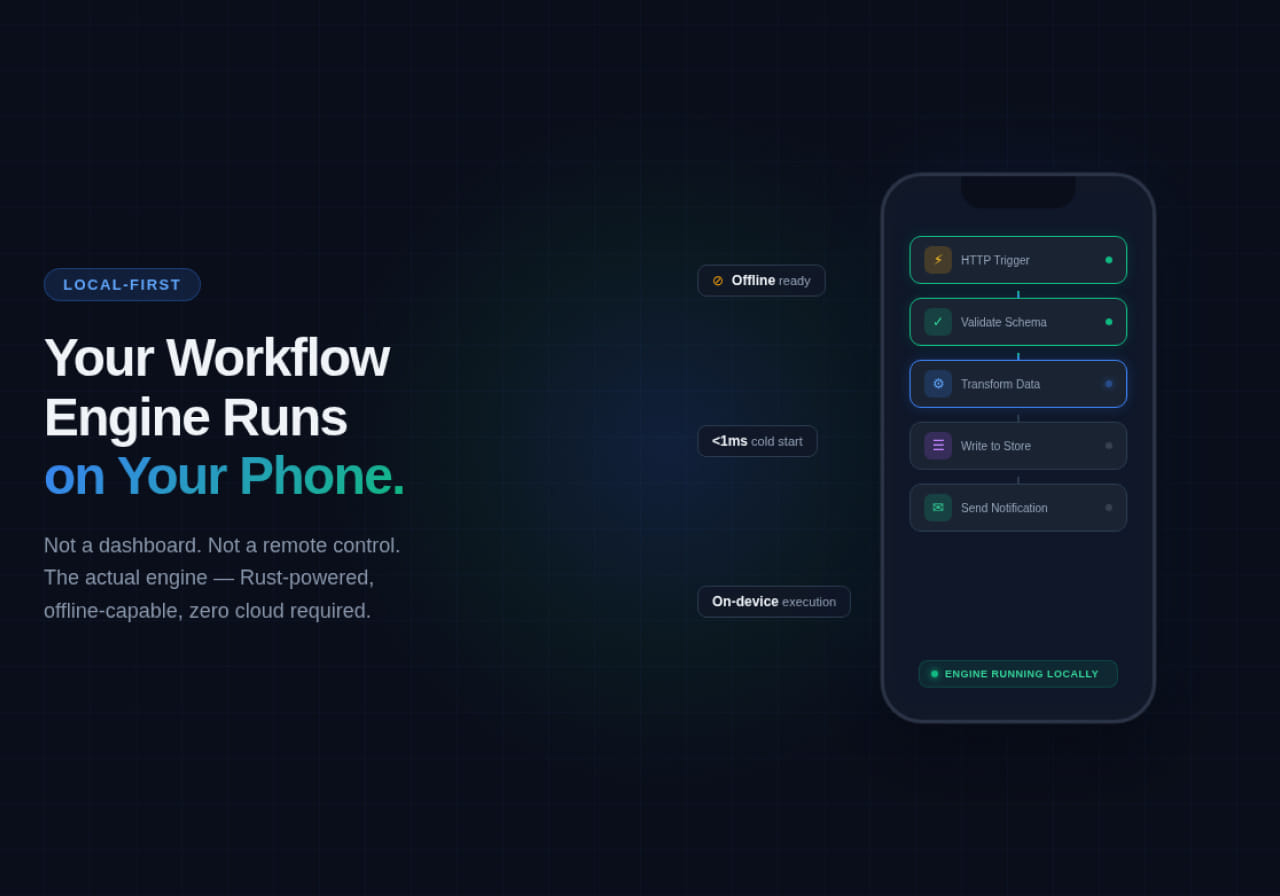
Your Workflow Engine Runs on Your Phone. No, Really.
When most automation tools say “mobile,” they mean you can open a dashboard on your phone and watch things happen somewhere else. The engine runs on a server. Your phone is a remote control.
Flow-Like is different. The workflow engine itself — the same Rust binary that does 244,000 executions per second on a server — runs directly on your phone. On the actual device. Your data never leaves it. No cloud signup, no external infrastructure, no connectivity required.
That’s not a mobile app that talks to a backend. That’s a workflow engine in your pocket.
Why this matters more than it sounds
The “runs on your phone” claim only makes sense if you understand what it unlocks.
Offline execution. Your phone loses signal on a factory floor, in a hospital basement, on a remote job site. Doesn’t matter. Workflows keep running. Data keeps flowing. When connectivity returns, everything syncs. There is no “sorry, we couldn’t reach the server” failure state.
Data sovereignty at the device level. Nothing is transmitted unless you tell it to be. Patient data stays on the tablet in the exam room. Inspection results stay on the phone at the job site. Audit logs are local and cryptographically chained — each entry signed and linked to the previous one, making any tampering immediately detectable. For teams in regulated industries — healthcare, government, defense, finance — this isn’t a nice-to-have. It’s a compliance requirement.
Zero-infrastructure deployment. There is no server to provision, no container to manage, no cloud account to create. Hand someone a device with Flow-Like installed. They have a workflow engine. That’s it. Scale means “more devices,” not “bigger cluster.”
What makes this technically possible
Most workflow engines are built on Python, Java, or Node.js runtimes that assume servers with gigabytes of RAM and always-on network connections. Running them on a phone would be like running Airflow on a Raspberry Pi — technically imaginable, practically miserable.
Flow-Like’s engine is written in Rust. That changes the constraints:
- Tiny footprint. The entire engine — not a client that talks to a server, the actual engine — fits comfortably on mobile hardware. No multi-gigabyte runtime. No bloated dependency tree.
- Sub-millisecond cold start. Open the app, workflows are ready. No JVM warm-up. No container spin-up. No loading screen while the runtime initializes.
- Minimal memory usage. Complex orchestration pipelines run in a fraction of the resources that Python or Java runtimes would demand for the same workload.
- No garbage collector pauses. Execution is deterministic. When a workflow step says it takes 2ms, it takes 2ms. Every time. This matters when you’re coordinating time-sensitive operations on resource-constrained hardware.
This isn’t about optimizing a cloud-native tool for mobile. It’s about building from day one for the constraint that your runtime might be a phone, an edge device, or an air-gapped server with limited resources.
Where “phone-first” workflows actually show up
The interesting use cases aren’t “check your automations on the go.” They’re situations where the phone is the primary compute environment.
Field operations and inspections. A technician walks through a facility with a tablet running Flow-Like. They trigger inspection workflows that validate data in real time, attach photos, check readings against thresholds, and generate compliance reports — all on-device. When they’re back in range, results sync to the central system. No paper forms. No “upload when you get back to the office.”
Healthcare and patient-adjacent workflows. A care coordinator uses a tablet to manage patient intake workflows in a clinic with unreliable WiFi. The workflow engine runs locally, processing structured data, routing approvals, and maintaining a complete audit trail. Patient data never touches an external server. HIPAA concerns around cloud processing simply don’t apply.
Emergency and incident response. When connectivity is the first thing that fails in a crisis, cloud-dependent automation fails with it. A local workflow engine means response coordination, resource tracking, and communication workflows keep running on whatever devices are available.
Retail and point-of-sale operations. Store managers run inventory workflows, approval chains, and reporting directly on a store tablet. No dependency on headquarters infrastructure. No downtime when the corporate VPN goes down.
What mobile looks like today
Flow-Like runs natively on both iOS and Android — you can build, run, and monitor workflows directly on your phone or tablet. The same Rust engine that powers the desktop and server versions compiles to ARM targets, so you’re getting real on-device execution, not a thin client.
On top of that, the responsive web app gives you full access to your workspace from any mobile browser, so even devices without the native app installed can participate.
This isn’t about mobile convenience. It’s about where compute happens.
The reason “workflow automation on your phone” matters isn’t that you can approve a request while waiting for coffee. Every tool with a mobile app can do that.
It matters because it represents a fundamentally different architecture. One where the workflow engine runs at the edge — on the device closest to the data, closest to the human, closest to the decision point. Your phone happens to be the most ubiquitous edge device on the planet.
When you choose where the engine runs, you choose where your data lives, how fast decisions happen, and what breaks when the network goes down. Flow-Like lets you choose “right here.”
Try it
Flow-Like is open source under the Business Source License. Native apps are available for iOS and Android. The web app runs on any device with a browser.
If you’ve been trying to solve “workflow automation that works without reliable connectivity” or “automation I can hand to field teams without setting up infrastructure,” this might be what you’re looking for.
Flow-Like is free for organizations under 2,000 employees and $300M annual revenue. Full source code access. No telemetry. No phone-home.
Get automation insights delivered
Sign up for our newsletter to receive the latest updates on Flow-Like, automation best practices, and industry insights. No spam — just valuable content.